How the involvement of Turkey in Belt and Road Initiative altered the bilateral trade relationship of Turkey and China
Abstract
This study explores the impact of Turkey’s involvement in China’s Belt and Road Initiative (BRI) on the bilateral trade relationship between the two nations. It employs a comparative and longitudinal analysis of Turkey’s export and import performance with China from 2016 to 2024. The findings are grounded in data sourced from the Turkish Statistical Institute and supplemented by diverse media and academic resources. Since Turkey joined the BRI in 2015, bilateral trade has experienced notable fluctuations, driven by infrastructure investments, geopolitical considerations, and economic strategies. The study begins by examining the literature on this topic, identifying gaps regarding BRI’s role in shaping trade dynamics. It then continues with the review of the historical development of Sino-Turkish relations, highlighting key milestones from the Cold War era to Turkey’s alignment with the BRI. The research concludes that while BRI has opened new opportunities for cooperation, its influnce was insufficient and internal and external political factors for Turkey played a more substantial role. These findings contribute to a deeper understanding of the evolving economic relationship between Turkey and China with regard to BRI.
Key Words: Belt and Road Initiative, Sino-Turkish Trade, Turkey-China Relations
Introduction The Belt and Road Initiative was declared in September 2013 by Xi Jinping while in a ceremony at Nazarbayev University in September 2013. It was his foreign policy initiative intended to fund infrastructure projects around the world and place China at the center of a major transnational production network. In November 2015 Turkey became a part of the Belt and Road Initiative two years after its announcement. Turkey’s president Recep Tayyip Erdoğan met with his Chinese counterpart Xi Jinping on the sidelines of the G20 summit in Antalya and signed a memorandum of understanding which practically made Turkey become involved BRI.
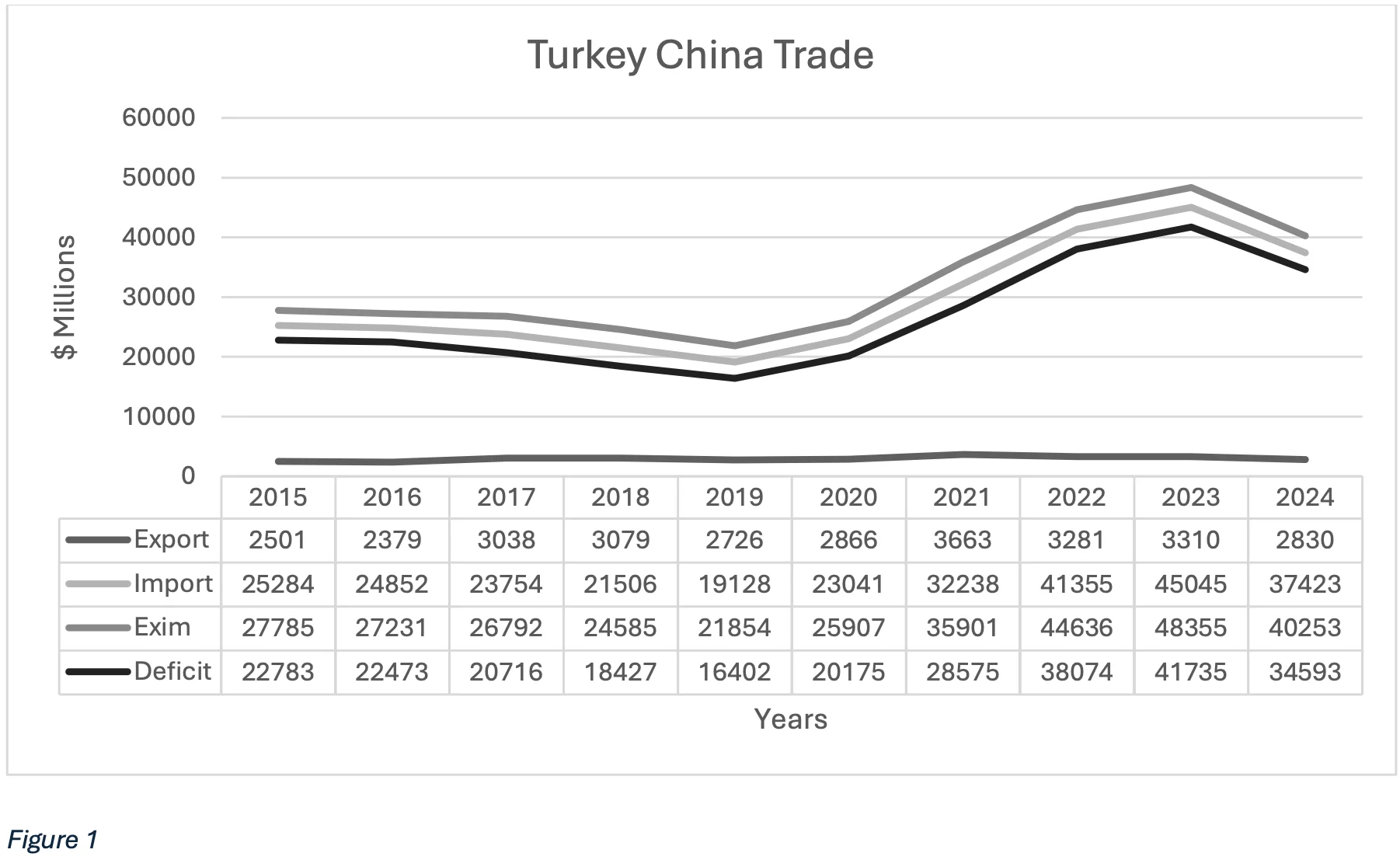
China is Turkey’s largest trading partner in Asia, and Belt and Road Initiative (BRI), in which bureaucrats and business community of Turkey has expressed keen interest, is viewed as an opportunity for Turkey to improve its economic relations with the world’s second largest economy. Since 2015 both sides have been subscribing to the idea that there should be greater cooperation in economic terms and maintaining a positive discourse along the way. The volume of the bilateral trade had actually experienced a gradual decline until 2019 when a steep rise followed. Even though BRI was seen as promising not just by politicians but also academic circles, processes and mechanism linked with it was not effective in the changing dynamics of the trade between the two. The years 2015 and 2019 were especially important in that the role Turkey attached to BRI was relatively more evident.
Driving from the ambiguousness of its effect this paper aims to examine BRI’s influence by asking the question “how the involvement of Turkey in Belt and Road Initiative altered the bilateral trade relationship of Turkey and China” . It starts with a literature review assessing the state of existing works and findings and gives justification for doing the research. After that, the methodology on which this research is conducted is laid down. Then a short introduction is given of the history of the relationship from the beginning to the year 2015, when Turkey became involved in BRI. Lastly the results of the survey are presented and discussed to some extent.
Methodology
This research is constructed on a comparative and longitudinal analysis making a direct comparison on a yearly basis. First made is an examination Turkey’s performance in export to and import from China on yearly basis from 2016 to 2024. Then each year’s figure is compared with other years to observe the changes in bilateral trade. In line with the research question, one group of data was used as the primary data set, which is the value in dollars of Turkey’s exports to and imports from China by year. Investigation was limited to the period between 2016 and 2024; however, previous years were also taken into consideration to understand the developments in the first years of the period. Statistics for exports and imports were acquired from TUİK and concerning the BRI related interactions a wide range of online media from state affiliated to independent, general or specialized were sourced. Collected data is organized in chronological order and presented in tables and charts.
The changes in bilateral trade relations are observed on a yearly basis. This is to see general trends side by side with BRI related interactions since BRI constitutes a long-term strategy having long range implications. The indications of the interactions are discussed to the extent that support their effects to the state of the trade. However, this analysis is not limited with only BRI related ones and included other significant politic, diplomatic, economic, military and social developments in the relationship thereby aiming to differentiate the influences of the former from the latter.
In the course of this research, faced with some inevitable problems affecting the accuracy of some of the analyzes. Directly linked with the context of the research question, the issue of identifying BRI related developments was problematic since there are no clear and official boundaries for BRI projects. Only the events with direct links are considered to be BRI related and no further inquiry is made in this regard. Another issue is that recorded figures for exports and imports in different sources, national and international, do not match each other. For the sake of not going beyond the aims of this research, only one source is used which is Turkish Statistical Institute. Even though this might affect the reliability of this study, differences are only minor and do not alter the outcome.
History of the bilateral relationship
Turkey’s relationship with China concerning trade opportunities between 1949 and 1971 hadn’t seen significant progress as it was subject to the sheer global polarization. In this period Ankara stood side by side with its NATO allies regarding almost all issues of security which was at the top of the agenda for Turkey. It was in a strong solidarity with South Korea and ROC against the threat of communist expansion. Although the intensity of Turkey’s political interest in East Asia had increased, it could not establish meaningful relations with the region in economic terms, especially with the PRC and North Korea, the communist countries which Turkey disregarded until the 1970s (Çolakoğlu, 2015, p. 9).
Beijing’s view of Turkey developed negatively for its pro-western behavior throughout these years. Chinese media discussed that Turkey’s dependence on USA had been causing its national industry to fall back:
The flooding of Turkish markets with US goods has been a serious blow to Turkey’s weak national industry. Production has dwindled constantly in the textile, leather, tobacco and other industries, and factories have closed down in large numbers. The dumping of US surplus farm produce has forced Turkey’s backward agriculture still further down. (Shichor, 2014, 194)
On the other hand, PRC was also putting efforts to establish economic relations with Turkey. A commercial delegation had come from China in November 1966 and a trade agreement had been signed between ROC and Turkey in 1969.
Sino-American rapprochement in 1971 led Turkey to normalize its East Asian policy and develop one that in line with its own interests. Turkey recognized PRC as the sole legitimate representative of China on August 5 of 1971 and established diplomatic relations three days later. Turkey began to see East Asia as an opportunity for economic expansion in the 1970s and 1980s. Ankara’s interest for China was due to the economic prospects it offered and imminent weight in global politics as a member of UNSC. Nonetheless, deteriorating relations with US and European Economic Community because of the Cyprus issue had led Turkey to consider China as a third way. However, its unstable governments and the economic crises of the 1970s prevented Turkey from establishing more rooted economic relations with China (Çolakoğlu, 2015, p. 11).
A new era, however, started with the 1980s in bilateral relations. In the 1980s, a strategy of opening toward the countries of Asia was commenced under the military regime of Kenan Evren and continued to accelerate with Turgut Özal’s civilian government that came to power in 1983 (Çolakoğlu, 2012, p. 134). High level visits among presidents, prime ministers, bureaucrats and businesspeople have begun to pay reciprocal visits creating a positive mood in the air. In 1981, upon the visit of Turkish Foreign Minister İlker Türkmen in May, an economic and technical cooperation agreement was signed between the two countries (Kohen, 1981) Both sides continued to explore mutual commercial opportunities until the collapse of USSR which signed a near change in their approach to each other.
After 1991, political strategies of Turkey and China shifted alongside with their new priorities and concerns and this shift interrupted the recorded progress in the previous decade. From the perspective of Ankara, the historical and cultural closeness with the newly established republics in Central Asia, Caucasus and Balkans could lead Turkey to build itself an area of influence. However, its increased interest over these geographies created a perception of pan-Turkish agenda put in work, which disturbed other powers in the regions, namely Russia and China. On the other hand, independence of Turkic countries in the Central Asia, Turkey’s long affinity with Uyghur diaspora and its impression among international public concerned Beijing about the possibility of a perceived pan-Turkish ideas to reach East Turkistan. Beijing, in response, slowed down its intercourse with Turkey and started to take oppressive measures in East Turkistan. Thus, Turkey’s expansion to Central Asia with the aim of domination had caused its relationship with China to deteriorate.
Another shift in Turkish foreign policy in mid 90s took place as part of adjustment to the post- cold war international system. This time Ankara acknowledged Russian and Chinese presence in Central Asia and sought for cooperation instead of rivalry. In May 1995, Turkish President Süleyman Demirel arranged a diplomatic tour of Asia including China where he tried to enlarge economic cooperation (Çevikcan & Bektaş, 1995). Ankara’s compliance with China’s demands regarding Uyghur opposition in Turkey opened way once again for diplomatic traffic. Nevertheless, China’s pressure on Turkey regarding East Turkistan issue had worked and as Altay Atlı pointed Turkey chose to cease its support for Uyghur nationalist movements and adopted a new policy of supporting the Uyghurs economically and culturally while rejecting any attempt that would jeopardize China’s territorial integrity (Atlı, 2018, p. 106).
The character of bilateral trade relations between Turkey and China from 2000 up until now can be identified with accelerated trade activity accompanied with commitments to greater growth yet bounded by chronic problems. Forms of economic activities are widened to the areas of defense industry and infrastructure projects. Within this context, the 2000s can be observed as a period in which Turkish Chinese relations experienced an unprecedented expansion and deepening in all aspects. (Selçuk Çolakoğlu, 2015, p. 14). The relationships fundamentally changed in the early 2000s while continuing mutual discourse on enlargement of commercial volume raised expectations.
In this period, Turkey started to pursue a multidimensional foreign policy by giving more importance to third world countries and prioritizing economic gains. China, in this context, stood for a desirable partner with profound opportunities to benefit.
Gul said Turkey and China have always been supporting and helping each other and share broad consensus on major international and regional issues. Turkey highly praises China’s enormous achievements in its economic and social development, he said, adding that Turkey hopes to work with China to further tap potential of bilateral economic cooperation and lift the ties to a new level. (Embassy of the People’s Republic of China in the Republic of Serbia, 2009)
On the other side, the reforms made in politic and economic landscapes and new global political orientation of Turkey in AKP era constituted the core reasons for China’s growing interest in Turkey. Also, Beijing valued its rapid economic growth and membership to G20 elite group.
Turkey is a member of G20 and is also an important newly emerging country and a large country in the Middle East region. It has for long done a great deal in safeguarding regional stability and promoting common development. In recent years, Turkey has participated in resolving the Afghanistan issue, the Iran nuclear issue, the Middle East peace process, and other international and regional hot issues… It will host the 2015 G20 summit. Turkey’s proactive, flexible, and all-dimensional foreign policy has enabled the country to play a more and more important role in international and regional affairs. The Chinese side appreciates this. (Çolakoğlu, 2012)
The discourse between AKP government and China started with the visit of elected Prime Minister Recep Tayyip Erdoğan to Beijing one week before his assumption in January 2003. This gave impetus to bilateral relationships in the following years, and commercial activities saw a continuous rise without disruption for ten years. A trade volume of 3 billion in 2003 peaked at the value of 29 billion in 2013 reaching nearly ten folds in a ten year’s timespan. Cooperation between the countries extended further to the areas of railway construction, energy and tourism. In June 2009, Turkish President Abdullah Gül went to China to make interactions regarding the feature of the relationship. This top-level visit was particularly considered special for taking the cooperation to the highest level (China Radio International, 2009). Yet this imminent progress would be subject to a formidable examination.
One week after Gul’s presence in East Turkistan as a part of his visit to China, a series protest broke out in Urumqi. The protest of a small crowd questioning the death of two young workers in Guangdong was turned into a mass riot because of Chinese fire on crowds. Chinese government forcefully suppressed the protests leaving hundreds of people dead or arrested. News and scenes of this horrific event caused immense reaction in Turkey both in public and political spheres. Ruling and opposition parties accused Chinese government for the violations of the human rights in Urumçi. Turkish Prime Minister Erdoğan harshly criticized the way of handling the protests noting that “… almost a massacre. We could transmit this issue to the UN General Assembly if required.” (Civaoğlu, 2009)
In the face of these reactions, the Chinese surprisingly remained indifferent seemingly escaping from escalating the tensions. Turkish bureaucracy, on the other hand, took immediate diplomatic measures for Erdoğan’s words. Turkish Ambassador to Beijing Murat Salim Esenli emphasized that Turkey had no intention of intervening in China’s internal affairs and that it desired for relations between the two countries to continue their course of development. Additionally, Foreign Minister Ahmet Davutoğlu made a phone call to his Chinese counterpart Yang Jiechi to discuss an easing of the tensions (Anadolu Agency, 2009). As a result of mutual efforts and will to get over with the problem prevailed the persuasion of long term aims.
The progressive discourse left in President Abdullah Gul’s visit is again assumed with the visit of Chinese Premier Wen Jiabao to Turkey in September 2010. During the visit he and Prime Minister Erdoğan signed the “Common Declaration for Establishing and Developing Strategic Cooperation Relations.” In this declaration included the maintenance of “the momentum of high-level exchange of visits, deepen political mutual trust and support each other on issues of core interest, further expand and deepen economic and trade cooperation on the basis of mutual benefit and reciprocity.” (Global Times, 2013). Also, Erdoğan set ambitious goals in increasing bilateral trade volume to $50 billion by 2015 and $100 billion by 2020 (Su, 2010). The positive state of the relationship could be seen in the subsequent visit of Turkish Foreign Minister Ahmet Davutoğlu to East Turkistan in October 2010 nearly one year after the Chinese government has isolated the region from outer world for some days.
The expansion of the trade volume followed an unfavorable pattern for Turkish side. There is a significant imbalance in trade as Turkey is running a large trade deficit with China. The bilateral trade volume in 2000 exceeded for the first time one billion by 1,441 billion dollars and Turkey’s export composed only seven percent of it. Two years later in April, vice premier of China Zhu Rongji while in a visit to Turkey said “the Chinese government is taking various measures to improve the balance.” (China.org.cn, 2002) At this time, the level of trade deficit amounted to 1,1 billion dollars. Despite all the commitments and attempts, the gap, let alone decreasing, had widened reaching 18.462 dollars. Later in a Turkey-China Business Forum taking place in July 2015, it is once again emphasized that the trade deficit should be overcome (Anadolu Agency, 2015).
Findings
The answer to the question how the involvement of Turkey in Belt and Road Initiative altered the bilateral trade relationship of Turkey and China could be given from different perspectives. After Turkey’s involvement in BRI, Turkey’s trade deficit had indeed shrunk for a period of time as could be seen in the figure 1. The percentage of Turkey’s exports in the bilateral trade volume had seen an uninterrupted increase, though very limited, from 9% in 2015 to 14 percent in 2019. Nevertheless, we cannot talk about a connection in this case regarding BRI. Setting aside a number or BRI related projects agreed on 2015 which would be far away from giving fruit, even indirect political implications in the context of Turkey’s political shift to China was not effective. This change was not also due to a better trading performance by Turkish side but rather a continuous fall in the volume which started in 2014. By 2019 the level of the trade had experienced a considerable fall equal to a quarter of the level reached in 2013, stopping at 21.854 billion dollars. Thus, instead of an improvement in the trade conditions in line with preceding commitments, the deterioration of the trade relations from 2013 to 2019 had been effective in shrinking the trade volume and in Turkey’s increasing share.
2019 was a year in which trade performance between the two was revised with Erdoğan’s visit to Beijing. As a result of the positive dialogue, bilateral trade recovered quickly by 2020, exceeded the previous record of 29 billion in 2021 and peaked at 48 billion in 2023. However, with this recovery Turkey’s trade deficit with China has reached new heights, which it maintained through 2000s. The record of 48 billion dollars in 2023 was accompanied by equally huge trade deficit of 42 billion dollars.
This development, however, was exclusively a result of the attempt made by Erdoğan in 2019 rather than BRI related interactions. Turkish president made clear that trade volume should reach to 50 billion dollars by 2024. On the other hand, Turkey’s interest in BRI seems to have faded. In fact, Turkey did not participate in the Belt and Road Forum held in April 2019. Also, as of now, 14 years old cooperation for “Edirne-Kars High Speed Train” projects seem to be inactive again. Therefore, it is safe to conclude that processes and mechanisms linked with BRI weren’t effective in the dynamics of the bilateral trade relationship.
Discussion
The state of the general relationship in and prior to 2016 deserves a closer look in understanding why the trade worsened. Leaving behind the fruitful G20 summit made in December 2015, it was indeed a disappointing year for the Chinese side regarding Turkey’s willingness to further enhance the relationship. Since 2013 was at the top of the agenda a tender for a missile defense system which had witnessed a series of back and forth between European and Chinese alternatives. In September 2013 Ankara chose a Chinese state-owned company—the China Precision Machinery Import-Export Corporation—as the preferred bidder for its long-range air and missile defense system contract. The rationale was that the Chinese were offering a lower price, favorable technology transfer conditions, and early delivery on the first batch of batteries. However, this wasn’t an end in itself but a plan to leverage its purchasing power against its NATO allies (Kibaroglu & Sazak, 2016). A year later in September 2014, President Erdoğan said “Some disagreements have emerged with China on the issues of joint production and technology transfer.” and “Talks are continuing despite that, but France, which is second on the list, has come up with a new offer. We are holding ongoing talks with France. Here, joint production is important to us.” (Kibaroglu & Sazak, 2016) Even though some other complications occurred after this, the contract process with China was finally cancelled in a time when most expected to be completed during G20 Summit in Antalya (Asia Times, 2015). This development came on top of another tender for Sinop Nuclear Power Plant opened in 2009, again expected to be won by China, yet given to a French-Japanese consortium in 2013 (Anadolu Agency, 2013). Hence, Ankara’s unwillingness to partner with China in major areas of cooperation caused the bilateral relationship to enter a negative atmosphere.
Even though 2019 was fruitful for reconsidering the state of the bilateral trade, it wasn’t as such for BRI. In fact, Turkey started to develop a malign view of BRI. For example, in April 2019, Turkey didn’t attend Belt and Road Forum, and the reason was said to be the realization of BRI‑linked debt troubles in other states. So, in the context of BRI things were not going smoothly. To understand the growth of the trade in the following years it is more essential to look Turkey’s internal and external orientation before 2019.
The transition to the new presidential regime was accompanied with severe economic challenges as Turkey faced with successive currency crises which was further aggravated by COVID-19 pandemic. These problems directed Turkish policymakers’ attention towards the Russia-China axis as a natural means of coming out of this conundrum (Öniş & Yalikun, 2021, p. 14). Erdoğan made a short visit to Beijing in July 2019 after his participation in the G20 Osaka Summit in Japan. The special visit to Beijing by a Turkish president was seen as a strong willingness to normalize the relationship with China. In this visit Erdoğan put a target for bilateral trade at an amount of US$50 billion in a five‑year time. Hence, the currency crisis in 2018–20 constituted a critical turning point in the political economy of Turkey-China relations.
One example for the inefficiency of BRI in the two countries’ trade from Turkey’s involvement in BRI in 2015 to 2024 would be the “Railroad Cooperation Agreement” signed at the same time with the memorandum of understanding for BRI in November 2015. It was an extension of a framework agreement reached five years ago about building a high-speed railway link between Kars and Edirne and was also to be a contribution to BRI by providing a complementary route to China-Central Asia-West Asia Economic Corridor. However, due to the consecutive inactivity, it is reconsidered in 2015 and then once again in July 2019 during Erdoğan’s visit to Beijing. Yet it is still under construction and there is no information about its current situation.
Conclusion
Until now Turkey’s relation with China have maintained a slow and complex course. Often challenged by recurring problems in the history of the relationship, they nevertheless have always managed to overcome the problems with the help of aligning mutual interests. Bilateral trade is an aspect of this relationship that reflects ups and downs along the road. The positive atmosphere achieved in the first decade after 2000 was not maintained in the second decade. Even though both sides became a strategic partner in 2010, there was mostly discordance in the following years.
The Belt and Road Initiative came to life in 2013 and was given a role in the relationship since 2015. That was a time when Turkey was trying to formulate its relationship with the west to push its interest in the region and globe and China was willing to support Ankara in its efforts. In this context Xi Jinping’s foreign initiative was seen as crucial in drawing the potential routes for Turkey. However, its preferences in internal and external orientation, without any focus on BRI, were more effective for the trade between the two countries. The role of BRI was very limited in influence in this period and developments related to it were inefficient.
Researchers examining the role of the Belt and Road Initiative in Turkey-China relations should also consider analyzing foreign direct investments which are more coherent with the aims of BRI. Additionally, the socio-political context and the sustainability of these investments should also be considered to provide a comprehensive evaluation of how the BRI shapes long-term economic cooperation. These areas are pivotal in understanding the economic and strategic implications of BRI on Turkey-China relations.
References
-
A new era will be heralded in our region based on stability and prosperity. (2017, May 2014). Presidency of the Republic of Turkey. Retrieved December 26, 2024, from https://www.tccb.gov.tr/en/news/542/75199/a-new-era-will-be-heralded-in-our-region- based-on-stability-and-prosperity
-
Atlı, A. (2018). China and Turkey sailing through rough waters. In J. Reardon-Anderson (ed.), The red star and the crescent (pp. 103–121). New York: Oxford University Press.
-
Atlı, A. (2022). Turkey’s relation with China and the Belt and Road Initiative. In J. Fulton (Ed.), Routledge handbook on China-Middle East relations (pp. 155–167). New York: Routledge.
-
Çevikcan, S., & Bektaş, Ü. (1995, May 24). Demirel visited the Forbidden City. Milliyet.
-
China and Turkey strengthen ties. (2009, June 23). China Radio International. Retrieved January 1, 2025, from http://turkish.cri.cn/882/2009/06/23/1s116202.htm
-
China, Turkey issue joint declaration on establishing strategic relationship of cooperation. (2010, October 9). Global Times. Retrieved January 1, 2025, from https://www.globaltimes.cn/content/580194.shtml
-
China, Turkey sign agreement to boost cooperation. (2002, April 17). China.org.cn. Retrieved January 1, 2025, from http://www.china.org.cn/english/2002/Apr/30829.htm
-
China’s response to global financial crisis. (2009, June 30). Embassy of the People’s Republic of China in the Republic of Serbia. Retrieved January 1, 2025, from https://rs.china-embassy.gov.cn/eng/xwdt/200906/t20090630_3343410.htm
-
Civaoğlu, G. (2009, July 25). “We will overcome this small wave”, Milliyet.
-
Çolakoğlu, S. (2012). Turkey’s East Asian Policy: From Security Concerns to Trade Partnerships. PERCEPTIONS: Journal of International Affairs, 17(4), 129-158.
-
Çolakoğlu, S. (2012, October 9). Chinese perceptions of Turkey: Analysis. Eurasia Review. https://www.eurasiareview.com/09102012-chinese-perceptions-of-turkey-analysis/
-
Çolakoğlu, S. (2015). Dynamics of Sino–Turkish relations: A Turkish perspective. East Asia, 32, 7–23.
-
Çolakoğlu, S. (2025). Turkey and China in the Eurasian landmass. In M. Sahakyan (Ed.), Routledge handbook of Chinese and Eurasian international relations (pp. 123–137). New York: Routledge.
-
Erdogan wants Turkey-China trade imbalance tackled. (2015, July 30). Anadolu Agency. Retrieved January 1, 2025, from https://www.aa.com.tr/en/politics/erdogan-wants-turkey-china-trade-imbalance-tackled/21188
-
Japan signs nuclear power plant deal with Turkey. (2013, May 3). Anadolu Agency. Retrieved January 1, 2025, from https://www.aa.com.tr/tr/ekonomi/japonya-ile-nukleer-santral-anlasmasi/249821
-
Kibaroglu, M., & Sazak, S. C. (2016, February 3). Turkey, China, and the air-defense missile dilemma. Defense One. https://www.defenseone.com/ideas/2016/02/turkey-china-air-defense-missile/125648/
-
Kohen, S. (1981, December 20). Turkey–China economic and technical cooperation agreement was signed. Milliyet.
-
Öniş, Z., & Yalikun, M. (2021). Emerging partnership in a post-Western world? The political economy of China-Turkey relations. Southeast European and Black Sea Studies, 21(4), 507–529.
-
Shichor, Y. (2014). Turkey and China in the post–Cold War world. In B. Gilley & A. O’Neil (Eds.), Middle powers and the rise of China (pp. 192–207). Georgetown University Press.
-
Su, Q. (2010, October 9). China, Turkey leaders aim for $100b trade target. China Daily. https://www.chinadaily.com.cn/china/2010-10/09/content_11387314.htm
-
Turkey to get railroads from China, not missiles. (2015, November 23). Asia Times. Retrieved January 1, 2025, from https://asiatimes.com/2015/11/turkey-to-get-railroads-from-china-not-missiles/
-
Turkish foreign minister Davutoğlu talks to his Chinese counterpart on the phone. (2009, July 12). Anadolu Agency. Retrieved January 1, 2025, from https://www.aa.com.tr/en/archive/turkish-foreign-minister-davutoglu-talks-to-his-chinese-counterpart-on-the-phone/427421